New carsharing study in the Metropole du Grand Paris highlights growth and deployment potential
In October 2025, the Métropole du Grand Paris (MGP), partner in the STEER-NWE project, published a comprehensive study on the evolution of carsharing services across its territory. The study, carried out by the Atelier Parisien d'Urbanisme (APUR), provides an in-depth analysis of the current carsharing landscape and identifies high-potential areas for future deployment.
The publication offers valuable insights for public authorities seeking to better understand how carsharing can be scaled up in metropolitan contexts, directly aligning with STEER-NWE’s objectives around integrated and inclusive e-carsharing systems.
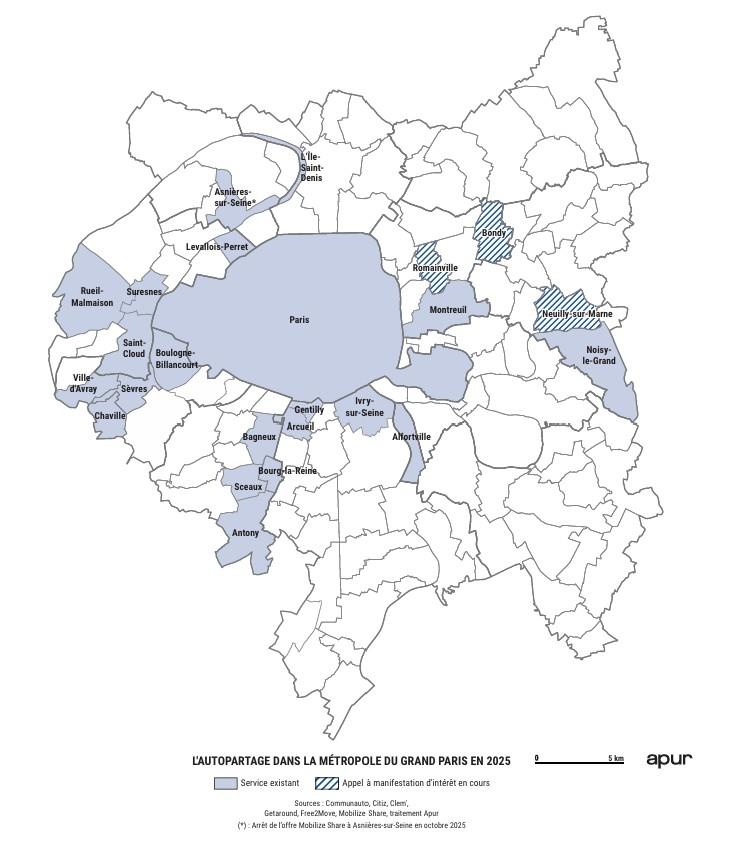
Carsharing Landscape in the Metropole du Grand Paris
According to the study, six carsharing operators are currently active within the MGP territory, three of which operate fully electric fleets. This reflects a growing diversification of services and a progressive electrification of shared mobility offers.
The analysis examines the spatial distribution of carsharing stations and vehicle usage patterns across the metropolitan area. By combining socio-demographic data, mobility indicators, and operational data from existing stations, the study identifies the key factors associated with higher levels of carsharing use.
What Drives Higher Carsharing Use?
The study highlights several characteristics of areas where carsharing stations show higher vehicle usage:
-
Lower reliance on cars for commuting: Areas with a high share of working residents who do not use a private car for daily commuting tend to show stronger carsharing uptake. Since carsharing primarily attracts occasional car users, it performs best where fewer active workers depend on a car every day.
-
Lower car ownership per household: Among households with a driving licence, usage is higher in neighbourhoods where households own fewer vehicles. Carsharing appears particularly attractive in areas where private car ownership is already limited.
-
Higher concentration of higher socio-professional categories (CSP+): The density of CSP+ households near a station correlates positively with vehicle use, suggesting socio-economic factors influence uptake.
-
Proximity to public transport: Stations located close to train stations or public transport stops show higher usage levels. The study confirms that strong public transport accessibility supports carsharing use rather than competing with it.
These findings reinforce the role of carsharing as a complementary mobility solution within multimodal urban systems.
From Analysis to Deployment Scenarios
Beyond descriptive analysis, the study identifies high-potential areas across the metropolitan territory and proposes several deployment scenarios that municipalities can use to structure their future carsharing offer. By mapping favourable conditions and analysing station performance, the research provides a practical basis for public authorities to plan expansion in a targeted and data-driven way.
Relevance for STEER-NWE
As a partner in STEER-NWE, the Metropole du Grand Paris contributes valuable metropolitan-scale expertise to the project. The findings of this study directly support STEER-NWE’s ambition to develop integrated e-carsharing models grounded in local context, data analysis, and strategic urban planning.
In particular, the study’s evidence on the relationship between carsharing use, public transport accessibility, and household car ownership offers important insights for designing inclusive and energy-efficient deployment strategies across North-West Europe.
The full study (in French) is available via APUR:🔗 https://www.apur.org/fr/mobilites-espace-public/evolution-mobilites/services-autopartage-metropole-grand-paris